Thursday, January 27, 2011

Cairns: Gateway to the Great Barrier Reef

Why is Cairns the Gateway to the Great Barrier Reef?

Cairns has long been known as the "Gateway to the Great Barrier Reef", due to the extensive reefs a short boat trip from Cairns and the surrounding coast.  The Great Barrier reef is an enormous, fascinating ecosystem running for thousands of km along the Queensland Coast.

When the reef is so long, what makes Cairns stand out as the best place to access it: its a combination of physical proximity to the city, excellent boats and dive trips, superb accomodation and food, but most of all, Cairns International Airport means that you can easily visit Cairns from anywhere in the world, and visit the reef the day you arrive.

Wednesday, January 26, 2011

Magic day and worlds largest flower in Cairns

Another magic day in Cairns today, so what better activity than going to see the world's largest, and worst smelling flower, the Titan Arum at the Cairns Botanic Gardens in Edge Hill. These fascinating and gargantuan plants were dismissed as mythical when first described until the first example finally flowered at Kew botanic gardens in the UK.

Check out my photos below (and a guest spot from David Attenborough)

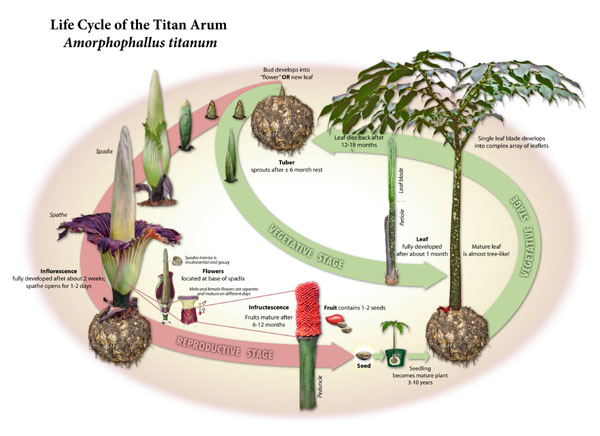
And check out the life cycle below: from University of Wisconsin Botany

Amorphophallus titanum (Becc.) Becc. ex Arcang.

Titan Arum, Corpse Flower, Bunga Bangkai

Data Archive of Blooming: 1889-2008


Facts about the Titan Arum

 Latin name: Amorphophallus titanum

 Other names: Titan Arum, Corpse flower, Bunga Bangkai

 Native habitat: equatorial rainforests of central Sumatra in Indonesia

 Family: Titan Arum is a member of the Family Araceae, the Aroids or Arum plants.

 First discovered: Italian botanist Odoardo Beccari discovered the Titan Arum in Sumatra in 1878. He sent seeds to England's Royal Botanic Gardens in Kew, where the first bloom of this species in cultivation occurred in 1889.

 First bloom in the U.S.: The Titan Arum bloomed for the first time in the United States at the New York Botanical Gardens in June of1937, where it became a sensation.

 Biology of the Titan Arum: The Titan Arum grows from a large corm that can weigh over 200 pounds; the blooming stalk can reach 10 feet and open to a diameter of three to four feet. Thousands of flowers are hidden inside at the base of the spadix, the fleshy central column. The large, frilly-edged, leafy "skirt" enclosing the spadix is the spathe, which when open resembles an upturned, fluted bell with a maroon interior. Only when the spathe is completely unfurled are the flowers mature. This entire, giant flowering structure is called an inflorescence.

 Male and female flowers are separate, with the female flowers receptive first, the male flowers releasing pollen the next day. In nature, this timing ensures cross-pollination with another Titan Arum flower; however, solitary cultivated blooms occasionally manage to self-pollinate.

 The spathe unfurls about 3-4 weeks after the bud tip first appears. The huge inflorescence opens abruptly - within hours - and typically stays open for only a few days. Collapse of the spadix takes place after three to five days. If flowers are successfully pollinated, the surrounding spathe eventually falls off, exposing the maturing seeds. When ripe, the cherry-sized fruits turn a bright orange-red, a color attractive to birds, which pick the berries off, digest the flesh and excrete the "pit" or seed. In this way, the plant is dispersed in nature.

 The fully open inflorescence emits a repulsive, "rotting-fish-with-burnt-sugar" scent. The odor, strongest at night, is to attract pollinators, which in Titan's Sumatran home are mainly carrion beetles and flesh flies. Most fly- and beetle-pollinated "carrion" flowers are similarly colored and perfumed.

 For most of its life, the plant regularly produces a single, umbrella-like leaf that is itself quite "titanic." In the wild, this leaf can reach 20 feet tall and 15 feet across. In cultivation the leaf usually grows 12 feet high, with the petiole as thick as a person's thigh before branching into a single, compound leaf.

The petiole is composed of honeycomb aerenchymatous core (mechanical function) surrender by compact unlignified tissue. It seems that the vascular bundles in mature petiole of Amorphophallus titanumhas the longest and widest metaxylem tracheids in plant kingdom! Only the end wall of these metaxylem tracheids have lignified secondary thickening. Mechanical stability of the petiole depends on the turgor pressure in the core and unlignified tissue. An individual leaf lives for over a year. The corm then enters a short dormant period before producing another leaf or - if you're very, very, lucky - a Bunga Bangkai.


 Mimicry of the petiole: The surface of Amorphophallus titanum petiole is covered with Lichen (Lichen thalli) looking patches, resembling a stiff tree trunk (mimicry) in order to prevent collision by animals.

 Smell and Heat during bloom: The Titan Arum smells and heats up during its bloom.

 Why do the Titans do this? The wonderful smell that these corpse flowers are famous for is composed primarily of fairly heavy, sulfur-based compounds that do not become airborne easily. The plant heats itself up in order to volatilize its "perfume," enabling the smell to go further, attract more flies, and increase the chance of pollination. To heat up, the plant "burns" stored carbohydrates, short-circuiting its basic respiratory process in order to maximize the production of heat. Many members of the Arum family perform metabolic burns like this, albeit on a smaller scale. Unfortunately, the enormous amount of energy the plant expends in attracting flies limits the amount of time it can bloom, which explains why these plants typically bloom for only a few days, and why they don't bloom every year.

 During bloom, the tip of the spadix (the central spike) is about human body temperature. The rest of the spadix is cooler (though still warmer than the surrounding air), but the surrounding spathe is cool. Oddly enough, the spadix below the tip is not a uniform temperature. One edge may be warmer than the rest of the spadix.


Sunday, January 23, 2011

Cairns Tourism Recovery after Queensland Floods (which even didn't affect Cairns!)

Cairns tourism operators are making a concerted effort to offer quality, unique experiences and value to tourists as the Cairns tourist industry tries to get back on its feet after the GFC, high interest rates and recently the Queensland floods, which caused a lot of travellers to put their plans off to travel to Cairns, even though we are about 1000km north of the flooding!


Check out Filip Binst's opinion below


Can Cairns Tourism Recover from the Floods?

The Cairns community has all been very excited to see Oprah on our screens, promoting Australia over the last week and we’re all hoping it helps boost tourism in the region.

With the recent flood events that have taken place around Queensland, a lot of tourists have understandably been cancelling their trips or choosing to travel elsewhere.

Hopefully with the help of Oprah though, tourists will start to realise that it is safe to travel to our state and to our region especially, where we saw little effects from the floods.

Cairns can only hope that the floods don’t affect tourism too much, and that any dip we might have experienced, will be helped along by campaigns from Tourism Queensland and from Oprah’s Australian show.

North Queensland to benefit from Sanctum shoot

The Cairns region is set to benefit from the filming of a major Hollywood film by avatar director James Cameron.  Shooting took place around Dunk Island and Mission Beach.

James Cameron's new movie filmed off Dunk Island

David Sexton

Thursday, March 25, 2010

© The Cairns Post


ISLANDS and rainforests of the Far North will serve as a backdrop to Hollywood director James Cameron's new $30 million 3D movie. 

Cameron's latest production Sanctum is an underwater thriller starring Australian actor Richard Roxburgh.

It is based on a near-death experience involving Australian co-producer Andrew Wright who survived a cave collapse in 1988.

Pictures: Filmed in the Far North

A date for its Australian release has not yet been announced.

While most of the movie has been filmed at the Warner Brothers Studio on the Gold Coast, a film crew also flew north for four days to get tropical footage at Dunk Island and Mission Beach.

Pictures: Cairns islands

They hired Cairns helicopter pilot Steve Spinaze to help with aerial shots.

"The crew were coming to an end of four months of filming on the Gold Coast and so were happy and really good to deal with," Mr Spinaze said.

"They wanted shots of the mainland and then shots for when the main character comes up on a beach.

"In the end we did about a dozen takes which will be cut back to just a few minutes of footage."

The crew stayed at Dunk Island Resort.

Sanctum is the first movie in the Far North to be shot using the Cameron-Pace 3D Camera with aerial mounts fitted.

Cameron earned an Oscar for his hugely popular 3D movie Avatar and some of the images in that movie were inspired by a trip on Skyrail.

Avatar artist Dylan Cole told San Francisco science-fiction website io9 that Cairns' tropical rainforests were an inspiration.

"For a lot of the jungle over views, I used photos that I had taken from the Kuranda Skyrail near Cairns, Australia," Mr Cole told the website.

Other big name productions to have been filmed in this area include The Thin Red Line, TV series The Pacific and Fool’s Gold with Matthew McConaughey and Kate Hudson.

Tourism Tropical North Queensland chief executive Rob Giason said movie production brought not just immediate benefits, but greater awareness of what the region had to offer.

"The challenge is always to get due recognition for the location where these movies are filmed," he said.

"In the long term we think are of great benefit."

Movie King:Parts of James Cameron's latest movie ofering Sanctum have been filmed off Dunk Island and Mission Beach.

Cairns and Great Barrier Reef to benefit from Thailand dive bans

Cairns is known around the world as the gateway to the Great Barrier Reef, the most famous dive spot on earth.  Cairns will become even more popular with divers following the closure of significant dive sites in Thailand


Thailand's loss is Great Barrier Reef's gain

Kelly Burns

Monday, January 24, 2011

© The Cairns Post


THAILAND is inadvertently handing the Great Barrier Reef diving industry a helping hand by closing seven of its best reefs.

The popular dive and snorkelling spots will be closed to tourists to let them rejuvenate after rising sea temperatures caused severe damage to the coral reefs.

But dive experts in Cairns say it could have a positive spin-off for tourism here.

Thailand’s reefs and cheap diving were a major drawcard for tourists who will now be forced to look elsewhere.

Pro Dive spokesman Andrew Wood said any impact would depend on what reefs had been closed and for how long, but if tourist hotspots were among them it could boost the Far Northern dive industry.

Tourists would have to look elsewhere for dive courses and it could mean more people doing courses in the Great Barrier Reef, he said.

Last week, 18 dive spots in seven marine parks in the Andaman Sea were closed on the orders of the Thai National Park, Wildlife and Plant Conservation Department.

Among them are popular Similan and Surin islands and Phi Phi.

The sites would remain off-limits to divers until the reefs had recovered and other areas would have restricted access, a spokesman said.

Authorities said excessive human activity near the reefs and unusually warm seas had led to widespread bleaching. Bleaching is where the warm waters forces coral to shred algae; giving it a white appearance.

Coral need algae for nourishment and can starve without it.

A study by Australia’s Centre of Excellence for Coral Reef Studies in October said reefs in South-East Asia and the Indian Ocean were dying from the worst bleaching in a decade.

World's biggest flower in Cairns

Cairns locals and toursts a like have been marvelling at the world's biggest flower, Titan Arum.  Big, and smelly!  Check it out!


From BunyipCo


Well as a tropical low develops over the city of Cairns, the Titan Arum in the Cairns Botanic Gardens continues to develop. It is a wet time but hundreds of people, both locals and tourists alike, visit the gardens each day to "see if it has opened". It might be a couple more days till it does but the spathe is starting to unfold and with it the smell is attracting an array of local insects. here we see a group if visitors and the arum, named Hannibal, in the background. Judi and Donn Corcoran have been keeping vigil at the "site" every day for a week. They have met a lot of folks!

The life cycle of the Titan Arum. The bulb can be massive weighing more than 100 lbs in some examples. [The would be a challenge, but would not deter our local Brush Turkeys from attempting to dismember a plant] (from the web)
Not only children find the smell repulsive. The foetid odour has been likened to rotting fish, gym socks, porta potties and the like. But it is the smell that attracts the potential pollinators.
"Hannibal" is in the foreground and "Spud" is just behind it. The idea is to have two plants flower at the same time. The reason is that the plant requires cross pollination to set seeds. In nature the strong odour wafts through the jungle deceiving a variety of insects that normally congregate on dead matter.

Fortunately, it does not appear that there are very specific pollinators, otherwise we might not have any luck with the plants in Cairns. The Titan Arum is native to Indonesia and we have few insects in common. It is thought that certain bees, called Sweat Bees, halictids that are attracted to human sweat for the salt and mineral content, are the pollinators in nature. But there are other more general visitors to dead animals that are also involved and we have plenty of them here in Cairns.

A patch was cut at the base of the plant so we could get an idea of what was going on inside. You can see the flies resting on the spathe.
Looking inside we can see the female parts sticking up and ready to be fertillised. The pollen is in the yellow capsules at the top, But it will not be released for a while. Since the plant must be cross pollinated to produce seed, holding back the pollen plant for a while would allow pollinators, in nature, to visit and bring pollen from other plants. This is the reason we have two plants that we hope will flower simultaneously. If you look carefully, you can see several insects in the flower.This is a bug, probably a Pirate Bug. It is here to feed on other small insects.

This is one of several species of blowfly that we have observed on the plant. This sort of blowfly is attracted to decaying animal matter. What is surprising about the flies on the Arum at this point is that they do not seem interested in feeding. They are "just there". [Look carefully!]
Two smaller blowflies.
Perched atop the female flower but with no mouthparts engaged in feeding.Here are a couple of blowflies and, either a small blowfly species of a fly of the family Muscidae and a Flesh Fly, Sarcophagidae. Flesh Flies breed in carrion and dung and usually have a greyish and striped appearance.
A flesh Fly and Blow Fly side by side.
Blowfly bliss. This fly seems quite content resting on the stigma. It made no attempt to feed. It was just "drawn" there.As noted above, careful observers would have seen these little cuties at the base of the stigmas. They are Springtails, order Collembola. These are arthropods that are no longer considered to be insects. They are of a different lineage. They are found in most habitats. They would have had to do some fancy "springing" to find themselves within the developing Arum titan. The would probably feed on the pollen and even some microorganisms that might also be attracted to flower.

This is "Spud", the second Titan Arum. It looks about a week away from flowering. We'll keep you posted. (By the way, the names were chosen by "Jacko", the gardener who has been caring for the plants. How he chose the names, well you'll have to ask him. He says all this is like waiting for the first child to be born!)

Thursday, January 13, 2011

Untitled

Cairns Safari reserve is on the market again 

FOR sale: 3 bedroom house on acreage near Kuranda, Cairns.  Great for animal lovers

Inclusions: 24 lions, four tigers, three bears, two cheetahs, seven hippos, one rhinoceros, seven monkeys, two pythons, two otters, various deer, four ostriches and 20 other birds, reptiles and animals.

Offers around $3 million: Properties like this are as rare a ostritches teeth!

Read the full news story:

Cairns Wildlife Safari Reserve on the market in the Cairns Post 

The Cairns Wildlife Safari Reserve is on the market, with expressions of interest being called for the zoo, near Kuranda.

No price tag has been put on the freehold property and business but its estimated value is more than $3 million.

Owner Jenny Jattke said she was selling to spend more time with her children and elderly parents.

Call of the wild: Jenny Jattke is selling Cairns Wildlife Safari Reserve, including cheetahs and monkeys, so she can spend more time with her family.

Sunday, January 2, 2011

Cairns Filmed on an iphone: Awesome


Modern technology has given us new ways to enjoy the timeless beauty of Cairns and surrounds.

This is really awesome

#Video Cairns Filmed On An iPhone 4 http://sockroll.com/cmlbg1


- sockrollMovies

08:14:08 PM Sunday 02 January