Another magic day in Cairns today, so what better activity than going to see the world's largest, and worst smelling flower, the Titan Arum at the Cairns Botanic Gardens in Edge Hill. These fascinating and gargantuan plants were dismissed as mythical when first described until the first example finally flowered at Kew botanic gardens in the UK.
Check out my photos below (and a guest spot from David Attenborough)


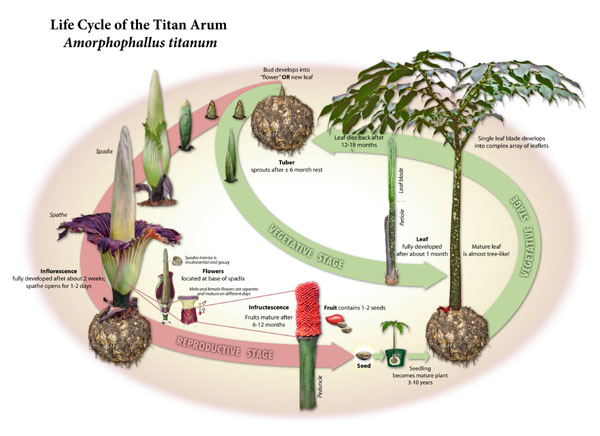
And check out the life cycle below: from University of Wisconsin Botany
Amorphophallus titanum (Becc.) Becc. ex Arcang.
Titan Arum, Corpse Flower, Bunga Bangkai
Data Archive of Blooming: 1889-2008
Facts about the Titan Arum
Latin name: Amorphophallus titanum
Other names: Titan Arum, Corpse flower, Bunga Bangkai
Native habitat: equatorial rainforests of central Sumatra in Indonesia
Family: Titan Arum is a member of the Family Araceae, the Aroids or Arum plants.
First discovered: Italian botanist Odoardo Beccari discovered the Titan Arum in Sumatra in 1878. He sent seeds to England's Royal Botanic Gardens in Kew, where the first bloom of this species in cultivation occurred in 1889.
First bloom in the U.S.: The Titan Arum bloomed for the first time in the United States at the New York Botanical Gardens in June of1937, where it became a sensation.
Biology of the Titan Arum: The Titan Arum grows from a large corm that can weigh over 200 pounds; the blooming stalk can reach 10 feet and open to a diameter of three to four feet. Thousands of flowers are hidden inside at the base of the spadix, the fleshy central column. The large, frilly-edged, leafy "skirt" enclosing the spadix is the spathe, which when open resembles an upturned, fluted bell with a maroon interior. Only when the spathe is completely unfurled are the flowers mature. This entire, giant flowering structure is called an inflorescence.
Male and female flowers are separate, with the female flowers receptive first, the male flowers releasing pollen the next day. In nature, this timing ensures cross-pollination with another Titan Arum flower; however, solitary cultivated blooms occasionally manage to self-pollinate.
The spathe unfurls about 3-4 weeks after the bud tip first appears. The huge inflorescence opens abruptly - within hours - and typically stays open for only a few days. Collapse of the spadix takes place after three to five days. If flowers are successfully pollinated, the surrounding spathe eventually falls off, exposing the maturing seeds. When ripe, the cherry-sized fruits turn a bright orange-red, a color attractive to birds, which pick the berries off, digest the flesh and excrete the "pit" or seed. In this way, the plant is dispersed in nature.
The fully open inflorescence emits a repulsive, "rotting-fish-with-burnt-sugar" scent. The odor, strongest at night, is to attract pollinators, which in Titan's Sumatran home are mainly carrion beetles and flesh flies. Most fly- and beetle-pollinated "carrion" flowers are similarly colored and perfumed.
For most of its life, the plant regularly produces a single, umbrella-like leaf that is itself quite "titanic." In the wild, this leaf can reach 20 feet tall and 15 feet across. In cultivation the leaf usually grows 12 feet high, with the petiole as thick as a person's thigh before branching into a single, compound leaf.
The petiole is composed of honeycomb aerenchymatous core (mechanical function) surrender by compact unlignified tissue. It seems that the vascular bundles in mature petiole of Amorphophallus titanumhas the longest and widest metaxylem tracheids in plant kingdom! Only the end wall of these metaxylem tracheids have lignified secondary thickening. Mechanical stability of the petiole depends on the turgor pressure in the core and unlignified tissue. An individual leaf lives for over a year. The corm then enters a short dormant period before producing another leaf or - if you're very, very, lucky - a Bunga Bangkai.

Mimicry of the petiole: The surface of Amorphophallus titanum petiole is covered with Lichen (Lichen thalli) looking patches, resembling a stiff tree trunk (mimicry) in order to prevent collision by animals.
Smell and Heat during bloom: The Titan Arum smells and heats up during its bloom.
Why do the Titans do this? The wonderful smell that these corpse flowers are famous for is composed primarily of fairly heavy, sulfur-based compounds that do not become airborne easily. The plant heats itself up in order to volatilize its "perfume," enabling the smell to go further, attract more flies, and increase the chance of pollination. To heat up, the plant "burns" stored carbohydrates, short-circuiting its basic respiratory process in order to maximize the production of heat. Many members of the Arum family perform metabolic burns like this, albeit on a smaller scale. Unfortunately, the enormous amount of energy the plant expends in attracting flies limits the amount of time it can bloom, which explains why these plants typically bloom for only a few days, and why they don't bloom every year.
During bloom, the tip of the spadix (the central spike) is about human body temperature. The rest of the spadix is cooler (though still warmer than the surrounding air), but the surrounding spathe is cool. Oddly enough, the spadix below the tip is not a uniform temperature. One edge may be warmer than the rest of the spadix.

No comments:
Post a Comment